

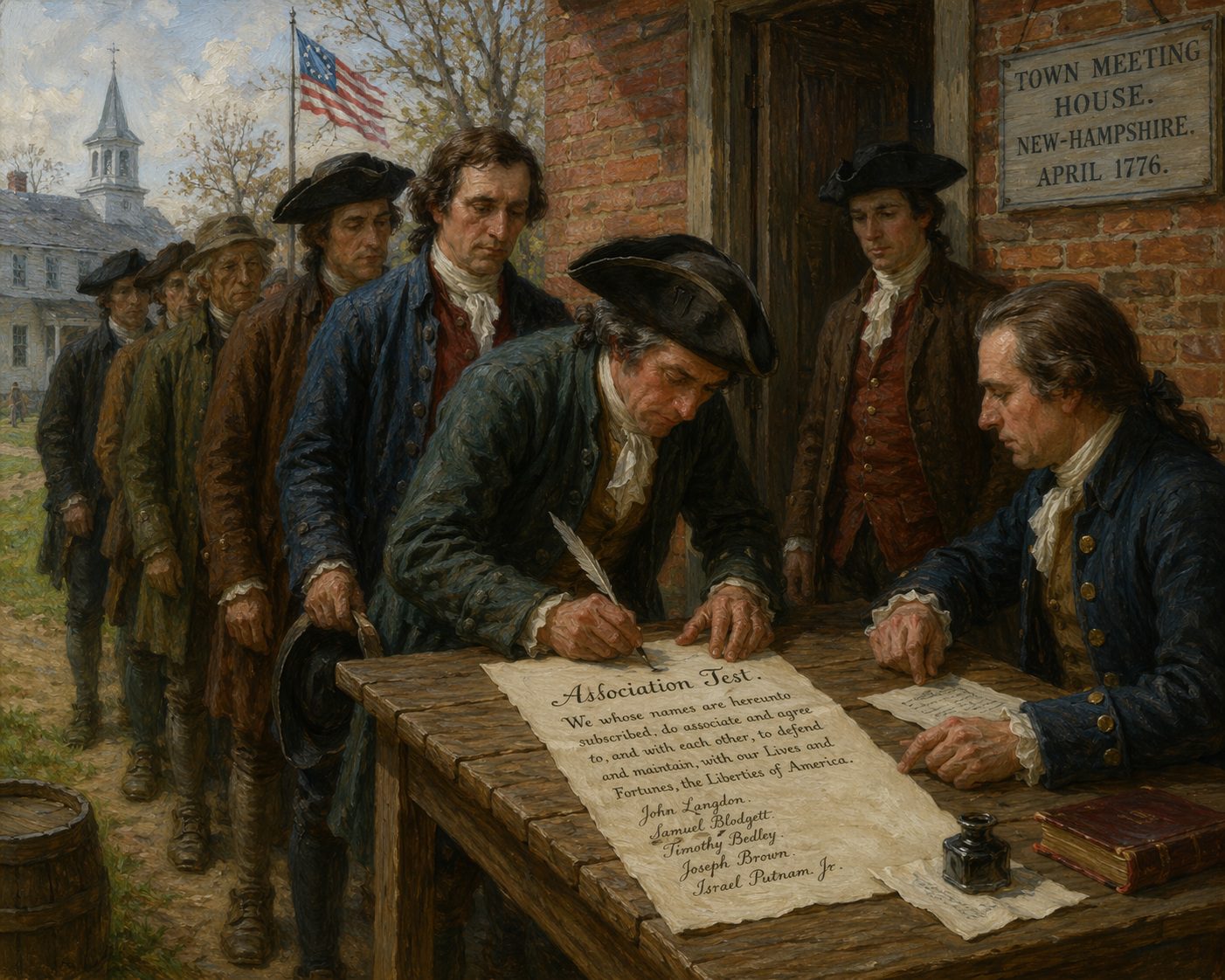
New Hampshire’s call to Commitment
On April 12, 1776 New Hampshire took a decisive step toward self government by requiring local towns to secure written pledges of loyalty from their citizens. In response to guidance issued by the Continental Congress resolution of March 14, 1776, New Hampshire required each town to obtain signed agreements from its citizens affirming their support for the American cause. This directive marked one of the earliest systematic efforts to measure and solidify public commitment to independence in the American colonies.

The March 14 resolution from the Continental Congress had encouraged colonial assemblies to suppress loyalist influence and ensure that those unwilling to support the patriot cause would not undermine the movement. While not yet a declaration of independence, it reflected a growing consensus that reconciliation with Great Britain was unlikely. New Hampshire, already at the forefront of revolutionary governance after establishing its own provisional government in January 1776, moved swiftly to implement this guidance.

Known historically as the Association Test of 1776, this measure compelled inhabitants to sign an agreement affirming their support for the revolutionary cause and their willingness to resist British authority. While less famous than later events, the adoption of this requirement represents one of the earliest systematic efforts in America to define civic responsibility through the expressed consent of the governed.
By the spring of 1776, New Hampshire had already broken important ground. In January, it became the first colony to establish an independent form of government when it adopted a . Yet political uncertainty remained. The Continental Congress had not yet declared independence, and loyalties within the population were divided. The Association Test was intended to clarify where residents stood and to strengthen the revolutionary movement from the ground up.
Under the April 12 directive, each town was instructed to present its inhabitants with a written declaration. By signing, individuals agreed to “oppose the hostile proceedings of the British fleets and armies,” and to defend the rights and liberties of the American colonies. Those who refused to sign were not automatically punished, but they were carefully noted. In some cases, non-signers faced social pressure, restrictions, or increased scrutiny by local committees of safety.
What made this requirement especially significant was its local character. Rather than relying solely on proclamations from distant leaders, New Hampshire entrusted towns – long the heart of civic life in New England – to carry out the process. Town meetings oversaw the collection of signatures, reinforcing the idea that political legitimacy flowed from community participation rather than royal decree. In effect, the Association Test functioned as an early referendum on independence, years before state and federal constitutions would formalize voting rights.
The surviving records from these association agreements offer historians a rare snapshot of Revolutionary – era society. Names of farmers, artisans, merchants, and laborers appear side by side, illustrating the breadth of participation in the revolutionary effort. Equally telling are the absences: women, enslaved people, and Indigenous residents were largely excluded from the formal political process, reminding us that the ideals of liberty were still unevenly applied.
Despite its limitations, the April 12, 1776 requirement marked an important evolution in American political culture. It linked freedom with obligation and framed citizenship as an active choice rather than a passive inheritance. By asking ordinary people to put their names to the cause, New Hampshire helped normalize the idea that governments derive authority from the explicit consent of the people they govern.
Today, the Association Test stands as an early expression of American civic identity. It underscores that independence did not arrive suddenly on July 4, 1776, but emerged through a series of deliberate steps taken town by town, signature by signature, in places like New Hampshire.
Sources
- New Hampshire. Provincial and State Papers of New Hampshire. Edited by Nathaniel Bouton, Isaac Weare Hammond, Albert Stillman Batchellor, Henry Harrison Metcalf, and Otis Grant Hammond. Vol. 30. Concord, NH: s.n., 1910. pages 2-167 (digital images, Internet Archive: (https://archive.org/details/provincialstatep30newh/page/n19/mode/2up).
- Cow Hampshire Blog, “New Hampshire Glossary: Association Test” A clear interpretive overview explaining the political purpose of the Association Test, its authorship under Meshech Weare, and its civic meaning.





Leave a Reply