
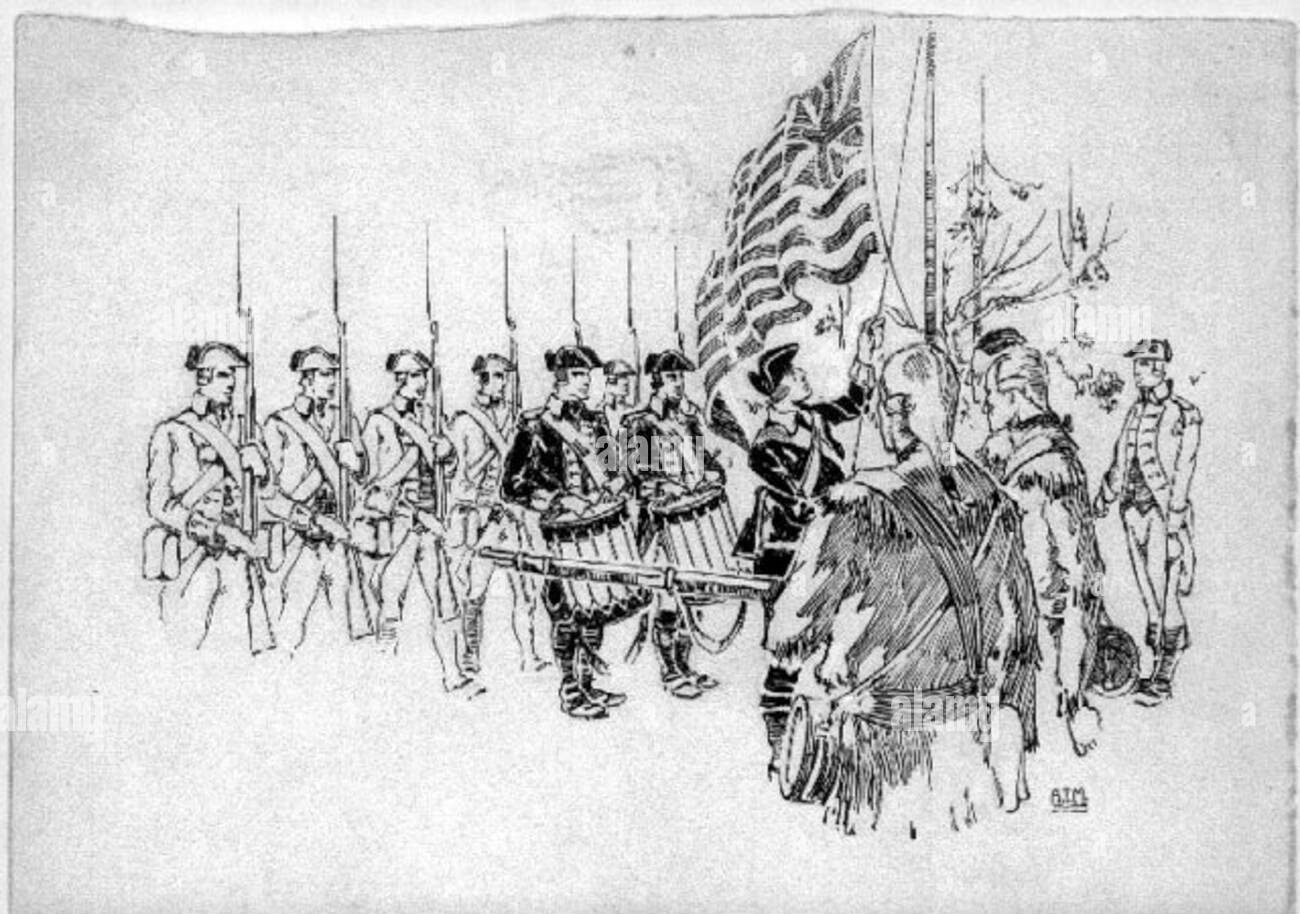
As we commemorate the 250th anniversary of our nation’s founding, it’s worth revisiting one of the most iconic moments in the American Revolution: the raising of the first American flag.

On January 1, 1776, General George Washington ordered a flag to be raised over Prospect Hill in what is now Somerville, Massachusetts. The Continental Army, entrenched outside Boston during the long winter siege, gathered to witness the ceremony. Washington intended the display to strengthen morale and signal growing unity among the colonies at a time when independence was yet to be formally declared and the outcome of the conflict remained uncertain.
Most Americans have long pictured this New Year’s Day event as the moment the first American flag flew over the Continental Army. The traditional story holds that Washington hoisted the Grand Union Flag, (aka the “Continental Colors”), featuring thirteen alternating red and white stripes, and the British Union Jack in the canton. The design symbolized both colonial unity and the lingering political reality of 1776: reconciliation had not been abandoned and the declaration of independence was still 6 months away.
Historians continue to debate exactly which flag was raised that day and what it symbolized. In more recent vexillological, (study of flags), research, scholars have revisited eyewitness language and 18th-century flag terminology. Exploring whether the “union flag” referenced in period accounts might have been the British Union Jack rather than the striped Continental Colors. In his 2006 paper The Flag on Prospect Hill, Peter Ansoff advanced the argument that Washington flew the Union Jack alone. Others, including Byron DeLear in his 2014 essay Revisiting the Flag at Prospect Hill: Grand Union or Just British? have defended the traditional interpretation that the Grand Union flag was raised.
A Symbol of Resolve
Regardless of which flag flew, the act of raising it carried immense significance. As described by the New England Historical Society, the ceremony boosted morale among the Continental troops and signaled a turning point in the struggle for independence. It was a bold statement of unity and determination at a time when the outcome of the Revolution was far from certain.
Together, these accounts remind us that America’s founding was not only fought on battlefields, but also shaped by symbols, ideas, and moments of shared purpose.
Huzzah!
Sources
- Wikipedia contributors. “Flag on Prospect Hill Debate.” Wikipedia, last modified December 2025. https://en.wikipedia.org/wiki/Flag_on_Prospect_Hill_debate.
- “The Raising of the First American Flag.” New England Historical Society. Accessed December 26, 2025. https://newenglandhistoricalsociety.com/the-raising-of-the-first-american-flag/.
- “Prospect Hill.” National Park Service. Accessed December 26, 2025. https://www.nps.gov/places/prospect-hill-ma.htm.
- Washington Raises the Flag at Prospect Hill.” Library of Congress: Printed Ephemera Collection. Accessed December 26, 2025. https://www.loc.gov/resource/rbpe.07905200/?st=text.




Leave a Reply